Key takeaways
- Start with a ten-minute inventory: dates, units, format and the material you have for each class.
- Fit the plan to the time you actually have, not an ideal schedule.
- Give each study block one specific job with a clear finish line.
- The night before, review your misses instead of restarting the whole course.
In this articleShow
The hard part about midterms is rarely one impossible chapter. It is the pile-up: a history essay, a chemistry test, a reading quiz, and a problem set all competing for the same few evenings. The way out is not to make one giant schedule that assumes you will study perfectly. Start by seeing the work clearly, then give each class a short, specific job. That makes it much easier to decide what to do when you sit down tonight.
Start with a ten-minute midterm inventory
Before opening a textbook, make one small list for every class with a midterm or major assessment. Include the date, the units it covers, the format if you know it, and what you already have: lecture notes, slides, problem sets, old quizzes, or a review sheet. You are not making a perfect study plan yet. You are making sure a quiet deadline or an entire unit does not disappear behind the loudest assignment.
- Mark the earliest test dates first, but also mark the classes where you have the least material organized.
- Separate recall-heavy work (terms, dates, definitions, formulas) from application-heavy work (problems, essays, source analysis, explaining a process). They need different kinds of practice.
- Choose one next action for each class: organize notes, make flashcards, take a practice test, work a problem set, or ask a teacher about one confusing topic.
Use the amount of time you actually have
A plan for two weeks should not look like a plan for two nights. If you have a week or more, rotate through each class in shorter sessions and come back to the hardest material after a gap. If you have three to six days, prioritize the units most likely to appear and get at least one self-test in for each class. If the test is tomorrow, do not try to learn every detail from scratch: review the highest-value topics, practice retrieving them without looking, and use missed questions to decide what gets the final block of your time.
Turn notes into something you can answer
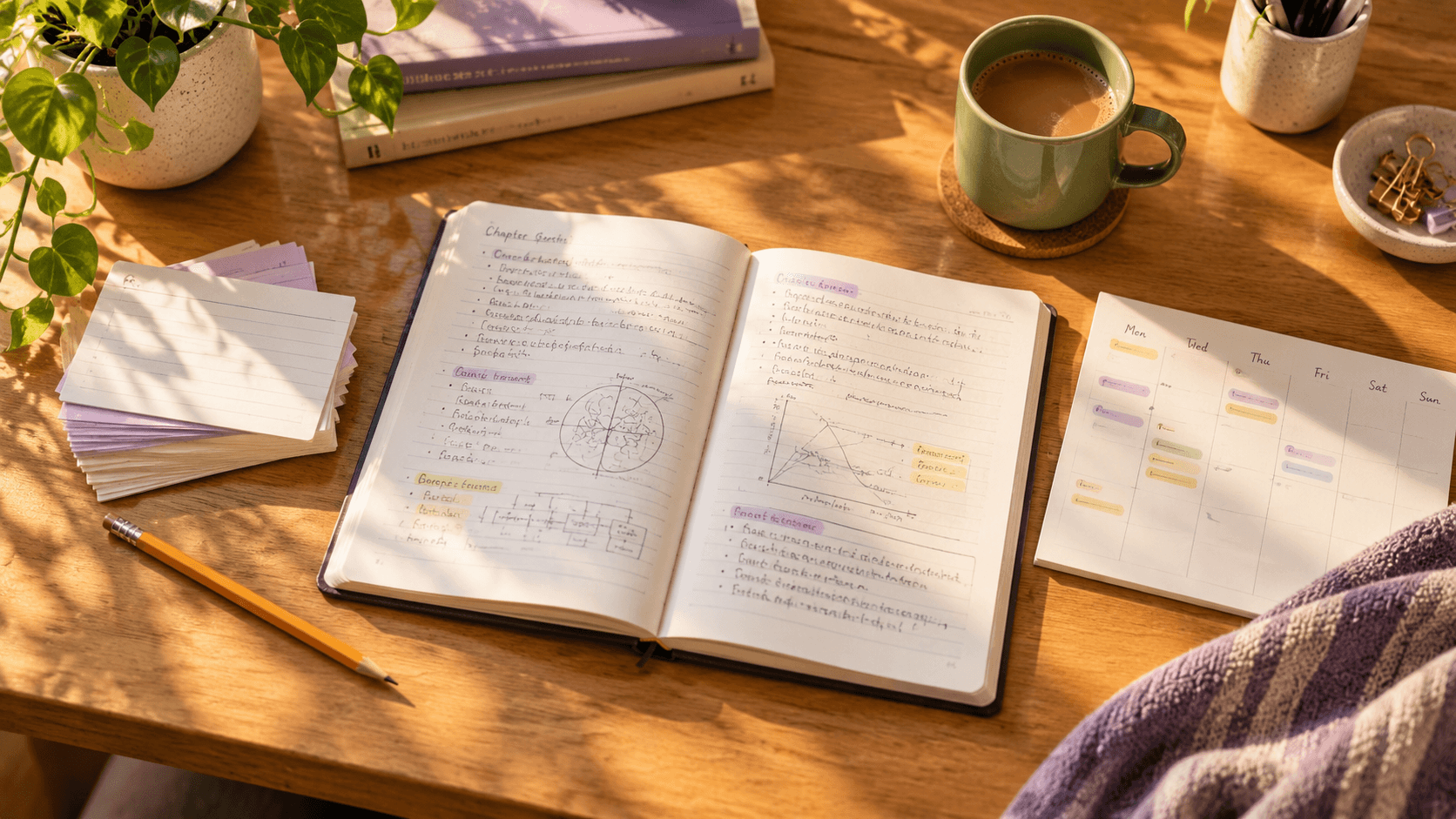
Rereading notes can be useful for finding the shape of a unit, but it is a weak way to find out whether you can use the material on a test. After a quick read, close the page and make yourself produce something: define the term, sketch the process, solve the next problem, explain the argument, or answer a question without looking. If you cannot do that, you found a useful gap. If you can, move on instead of spending another ten minutes highlighting the same paragraph.
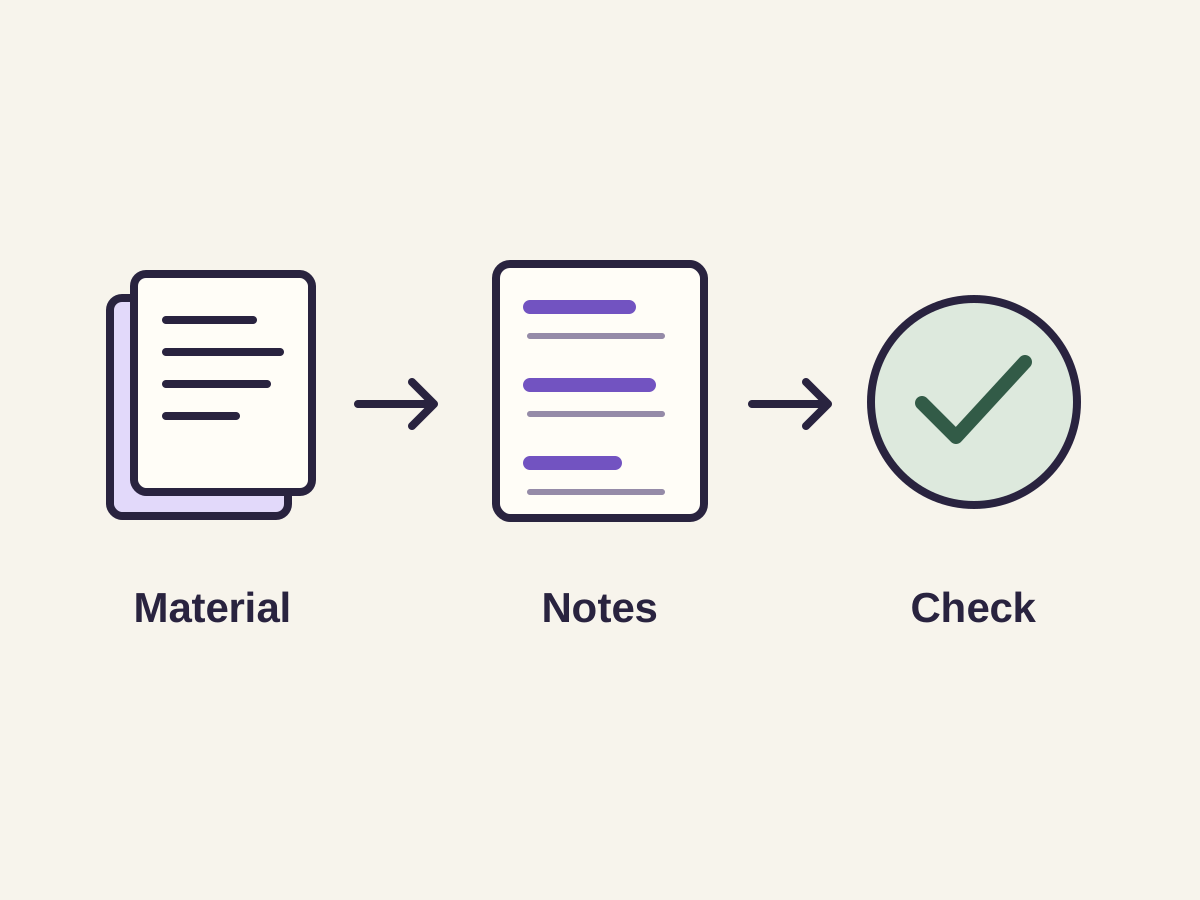
- Use Studi Notes to pull a messy lecture, PDF, or slide deck into a cleaner study document before review starts.
- Make flashcards for vocabulary, dates, formulas, and short explanations you need to retrieve quickly.
- Use practice tests for the questions that need a decision, a calculation, or an explanation rather than just recognition.
- Write down what you miss. A short list of real misses is more useful than restarting the whole unit every time you study.
Give each study block one job
A vague block called 'study biology' invites procrastination because there is no obvious first move. A block called 'answer ten cell-respiration flashcards, then check the two I missed' has a finish line. Keep the jobs small enough to complete, especially when you are switching between classes. You can make the next block from what went wrong in the last one instead of guessing what deserves more time.
The night before: narrow the work, do not restart it
The final review is for connecting loose ends, not for rebuilding every note. Revisit your missed-question list, the formulas or terms that still hesitate, and one or two representative problems or prompts. Pack what you need for the next day, stop at a reasonable time, and leave yourself enough room to think during the exam. A frantic new study system at midnight usually creates more noise than learning.
What to do when you are stuck on one concept
Do a real attempt first. Then compare it with the notes, a worked example, or a teacher's explanation and name the exact step that broke down. Ollie Chat can help you ask about the class material you uploaded, but it works best when your question is specific: 'Why does this step change the sign?' is more useful than 'Explain the whole unit.' Keep checking important answers against your course material, especially before an exam.
Questions students ask
How early should I start studying for midterms?
Start as soon as you know the dates and covered units. Even a short inventory gives you time to notice which class needs organized notes, practice problems, or help before the final few days.
Should I study one subject all day or switch subjects?
Use the approach that helps you stay focused, but give each session one concrete task. Shorter blocks across classes can work well when several midterms are close together, especially if you return to the hard material after a break.
What is the best thing to do the night before a midterm?
Review the gaps you already found, do a small amount of active recall or representative practice, and avoid trying to rebuild the entire course. Save enough time to rest and arrive prepared.

About the author
Ben Hirsch
Founder of Studi
Ben Hirsch founded Studi to make studying from your own class material faster. He works on the product and writes about study methods students can actually keep up with during a busy semester.
More from Ben HirschKeep studying
Keep reading
- Study Tips· 6 min readWhat an AI Lecture Note Taker Actually Does (and How to Use One Well)Turning a messy lecture into clean notes automatically sounds like magic, but it's a specific, understandable process with specific failure points. Here's what an AI lecture note taker actually does, what to watch for, and how to use it as part of a real study routine rather than a replacement for one.
 By Pranay
 - Study Tips· 6 min readHow to Turn Lecture Notes Into Flashcards (4 Ways — One Is Instant)If you're staring at a wall of lecture notes wondering how they're supposed to become something you can actually study from, here are four ways to get there — including the one that takes about 15 seconds.
 By Ben Hirsch
 - Study Methods· 6 min readHow to Use an AI Tutor for Studying (And When Not To)An AI tutor is available at midnight before a test, never gets impatient with the same question asked three different ways, and can re-explain a concept from a completely different angle instantly. It's also not the right tool for everything. Here's how to actually use one.By Ben Hirsch


Ready to try it on your own notes?
Start from the same class material you are already reviewing, then choose the study format that helps most.
Build My Study SetTrusted by hundreds of users